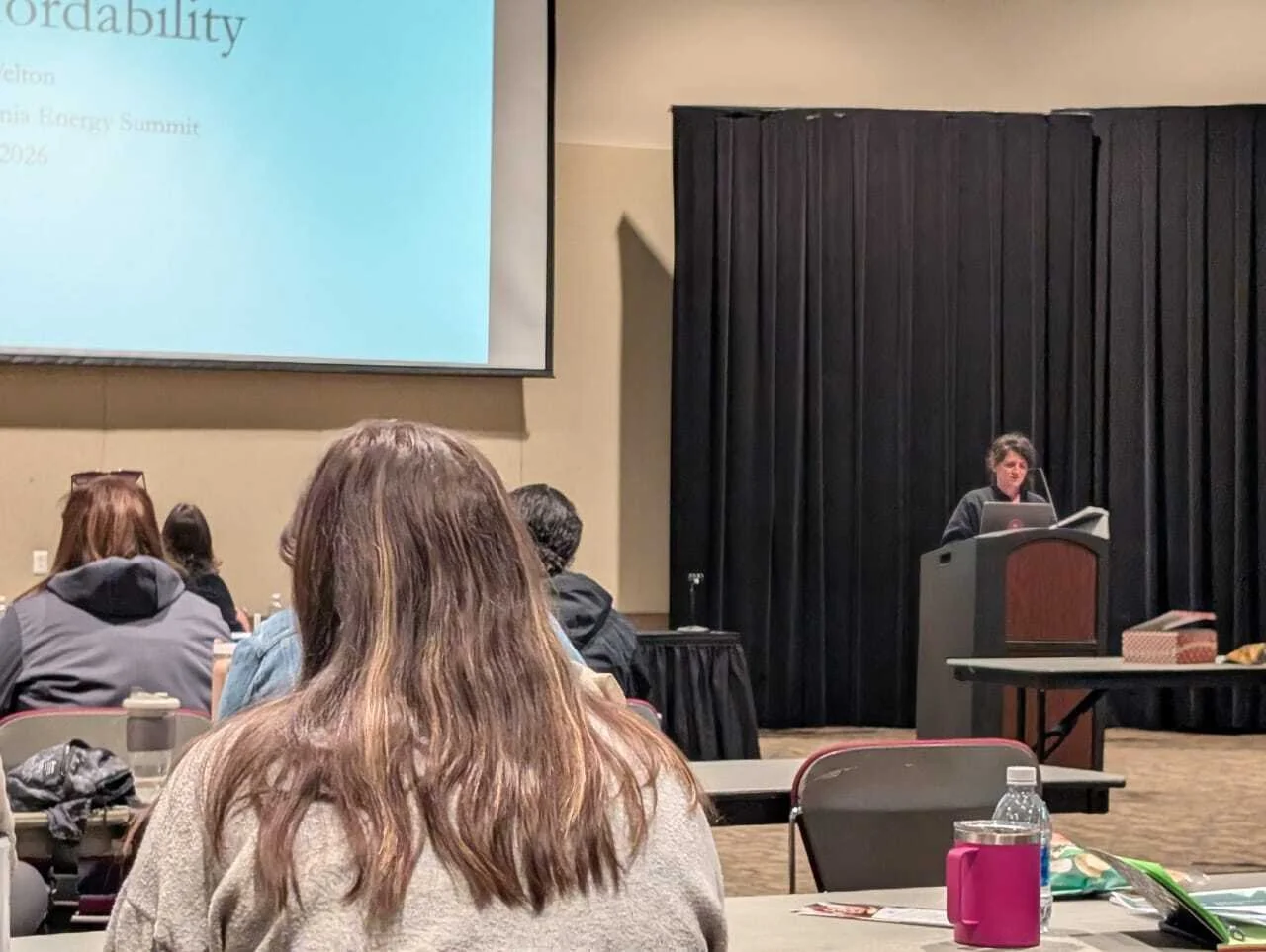
The second “Energy Summit” in Central PA: navigating the challenges to access and affordability in the current energy landscape.
On the morning of May 14, 2026, the ballroom of the Kehr Union building at Bloomsburg University in Central Pennsylvania filled once more with a diverse group of representatives from PPL, Geisinger Health, Pennsylvania Utility Law Project, Union-Snyder, Central Susquehanna Opportunities, Pennsylvania Public Utility Commission (PUC), UPenn, and Temple. It was a gathering only made possible through a common concern: the equitable provision of energy throughout the state.
The keynote speaker for the day, Kimberly M. Barrow, vice chair of the PA PUC, candidly explained the historical roots for why Pennsylvanian’s feel that affordable energy services are so out of reach today. Looking back a couple of years, most people remember 2021’s winter storm Uri and those with eyes on U.S. energy production recall the catastrophic failure of the Texas grid. The storm’s impact shocked the country, but the results of Uri could be easily blamed on Texas’s unique standalone power grid. As with many others, Barrow admitted that she did not see the storm as a portent for the Eastern Interconnect. However, come 2022 winter storm Elliott hit the region’s system hard. Unbeknownst to the families gathered together for the holiday season, Barrow saw the entire Eastern Interconnect teetering on the edge of brown and blackouts across the board. Aging infrastructures and unexpected increases in demand from e-vehicles all put the system on the backfoot. Winter storm Elliott alone represented a wake-up call and then the rush for data centers began. Rather than taking time to shore up energy production, demand skyrocketed without a clear plan in place for how the PUC would meet the surge and ensure affordable, reliable access for all. It is at this current juncture, precarious and uncertain, that those gathered at the summit work to provide basic energy needs across central Pennsylvania.
From local concerns to big picture problems
The day's panelists spoke in two distinct registers. Half of the panelists framed the issues at hand from the perspective of local struggles to overarching problems of energy production and distribution. The remaining panelists took a nuts and bolts approach as they unpacked the actual measures and programs available for securing energy for those in need of assistance.
Panelists made it clear how energy issues in PA intersect a wide range of concerns from domestic violence, to chronic health problems, and elder care. Elizabeth Marx from the Pennsylvania Utility Law Project (PULP) made clear just how deep the problem goes. She revealed that 1 in 4 households struggle to pay their energy bill and 1 in 20 stand $1200 in debt to the utilities. From 2006 to 2025 the price of 500 KWH nearly doubled. External factors like the rise of data centers only contribute to this pressure. Meanwhile structural factors, like the “shopping” of energy providers enabled by the 1996 energy deregulation, create a predatory environment for consumers. Providers offering lower introductory rates appear like a reprieve from exorbitant energy costs until variable rates quietly kick in and jack up the price. On the other end of the spectrum, Shelley Welton from UPenn offered a novel framework for thinking through the ways we can holistically energy affordability. In the slide below (figure 1) she breaks down responses along two dimensions: the life cycle of the energy from production to consumption and whether the intervention preempts or reacts to the problem. With this visualisation she draws attention towards the potential areas where new interventions could be made. In specific she points towards the potential of targeting affordability upstream at the level of energy production in that top left hand quadrant. The exercise reframes energy affordability as a structural issue and reveals the ambitious policy measures that stem from this viewpoint. Overall these framings simply help contextualize the precarity of the energy landscape as a multi-dimensional problem that requires an accurate grasp of its depth and scope in order to begin addressing the issue.
Figure 1. Areas for Intervening in Energy Affordability
The nuts and bolts panels echoed a common theme from the 2024 summit: community based organizations and utility to companies coming together to address energy precarity. Utility company representatives drew attention towards the importance of communication around assistive services before customers reach a crisis. Taking actions like energy audits or weatherizing old homes plays an incredibly important role in lowering energy bills, but these only serve as preemptive measures. The utilities often see people once they have accumulated immense burdens and need immediate assistance rather than long term solutions. Increased communication between organizations and the public also serves to dispel misconceptions about who is able to receive assistance. For nearly all the programs mentioned throughout the day, assistance requirements only necessitated meeting the set income level. Some options also remain fairly obscure even within the energy provider world. Giovann Ortiz, another member of PULP mentioned the fact that medical certificates can cease utility termination for up to 30 days, a life-saving measure for those relying on powered medical devices. Moments like these reinforce the importance of gathering together and sharing information as a practical step in alleviating energy precarity.
The Lingering Question
At the end of the day, one question hung over the proceedings. What does affordability mean? In a purely numerical sense, speakers floated the figure of six percent of household income as the widely accepted affordable rate. In actuality, energy costs sit either well above or well below six percent for many households. Even if the rate represented a flat six percent, that would still not reflect the difference that six percent makes across different livelihoods. This fact reflects an unfortunate reality of inequality stretching beyond just energy precarity. While the day’s talks emphasized the many struggles entrenched in energy services, the question of affordability reveals the flip side. Energy and its accessibility are entrenched within bigger questions of poverty and profit seeking. The underlying tension of this fact lent the day its sober tone. The question, why focus on energy poverty rather than poverty at large, did arise in the proceedings. The answer appeared both pragmatic and straightforward. It is an effective place to start acting. In this sense, the summit brought a sense of hope. Even in the face of crushing overarching structures, so many people still come out to share their knowledge and efforts to meet these issues where they can. We can ask ourselves what affordability really means while also learning how to turn the lights back on or bring back the heat for another week, another month, or another year.