
The Long Afterlives of Alternative Fuels
A word of caution on “energy transitions”
date
The term “energy transition” is a popular one, capturing the imagination of policymakers and scholars alike. For historians, it offers a convenient framing device for examining moments in which one fuel appears to displace another. For policymakers, it provides a conceptual architecture for setting decarbonization targets. At the same time, there is an increasingly critical literature questioning the usefulness of the term. Energy historian Jean-Baptiste Fressoz, for example, argues that “different energy sources, materials, and technologies are highly interdependent and everything expands together” [1]. While the ratios of fuels in the energy mix may change, absolute levels of energy use often increase, leading scholars such as Richard York and Shannon Bell to describe historical change as energy addition rather than transition [2].
This blog post adds a small empirical caution to these critiques, focusing on the persistence of so-called “old” fuels well into periods commonly understood as transitional. The more direct inspiration comes from Mark Aldrich’s excellent article, “The Rise and Decline of the Kerosene Kitchen.” Examining a lesser-known cooking fuel between 1870 and 1950, Aldrich emphasizes not only persistence but unevenness. As he notes, “energy transitions differ between men and women and are contingent upon economic status and place of residence” [3:25]. Rather than asking whether the United States “completed” an energy transition in the mid-twentieth century, this post examines which fuels persisted alongside electrification, where they persisted, and for whom.
Data, Methods – and following along!
The dataset being used throughout this post was downloaded from the National Historical GIS (NHGIS), a project of IPUMS. If readers want to follow along with the exploratory analysis below, they will need to register for an account with NHGIS to be able to download the relevant files. From there, code and instructions can be found at this GitHub repository.
The data used comes from the 1960 Census of Population and Housing as well as the 1970 Census of Population and Housing, both originally created by the United States Census Bureau and both digitized through the NHGIS project [4, 5]. For the 1960s, data pertains to house heating fuels. For the 1970s, data pertains to house heating fuels, cooking fuels, and water heating fuels. Additionally, the 1970s datasets offer breakdowns by ethnicity. The breakdowns on offer are, anachronistically, “Negro” and “Spanish-American”. Data is aggregated at the census tract level and is available for most major cities in the United States and their surroundings.
After painting a general national picture of fuel use in the United States between the years of 1960-1970, the remainder of analysis will take a case-study approach. New York, Washington and California were chosen for this study due to their role in on-going research projects in the Energy Geography Network. Comparisons and analysis will be temporal, geographic, and finally along lines of social unevenness.
Time
When aggregating heating fuels nationally, some clear trends begin to emerge. The most notable of these is the decline of coal from the heating mix across the board. Coal’s role in the heating mix seems to have been displaced by a slowly rising share of electrical heating and utility gas network expansion. Wood, already marginal in 1960, declined further. Notably though, the share of kerosene in the mix of heating fuels used across America stayed relatively stable. Further, there is geographic variation in the heating mix. To examine this in more detail, we turn to a comparison of New York, Washington and California.
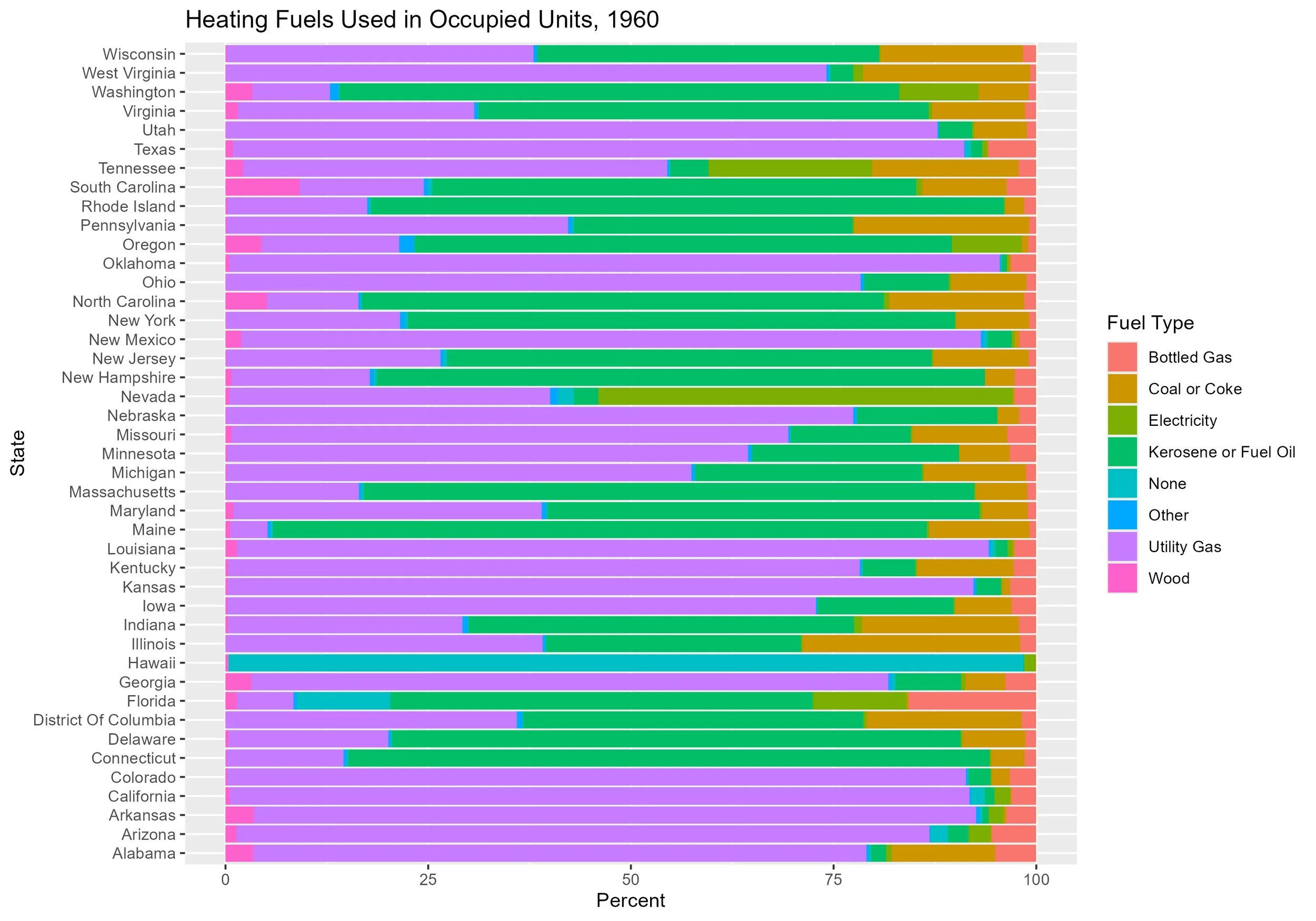
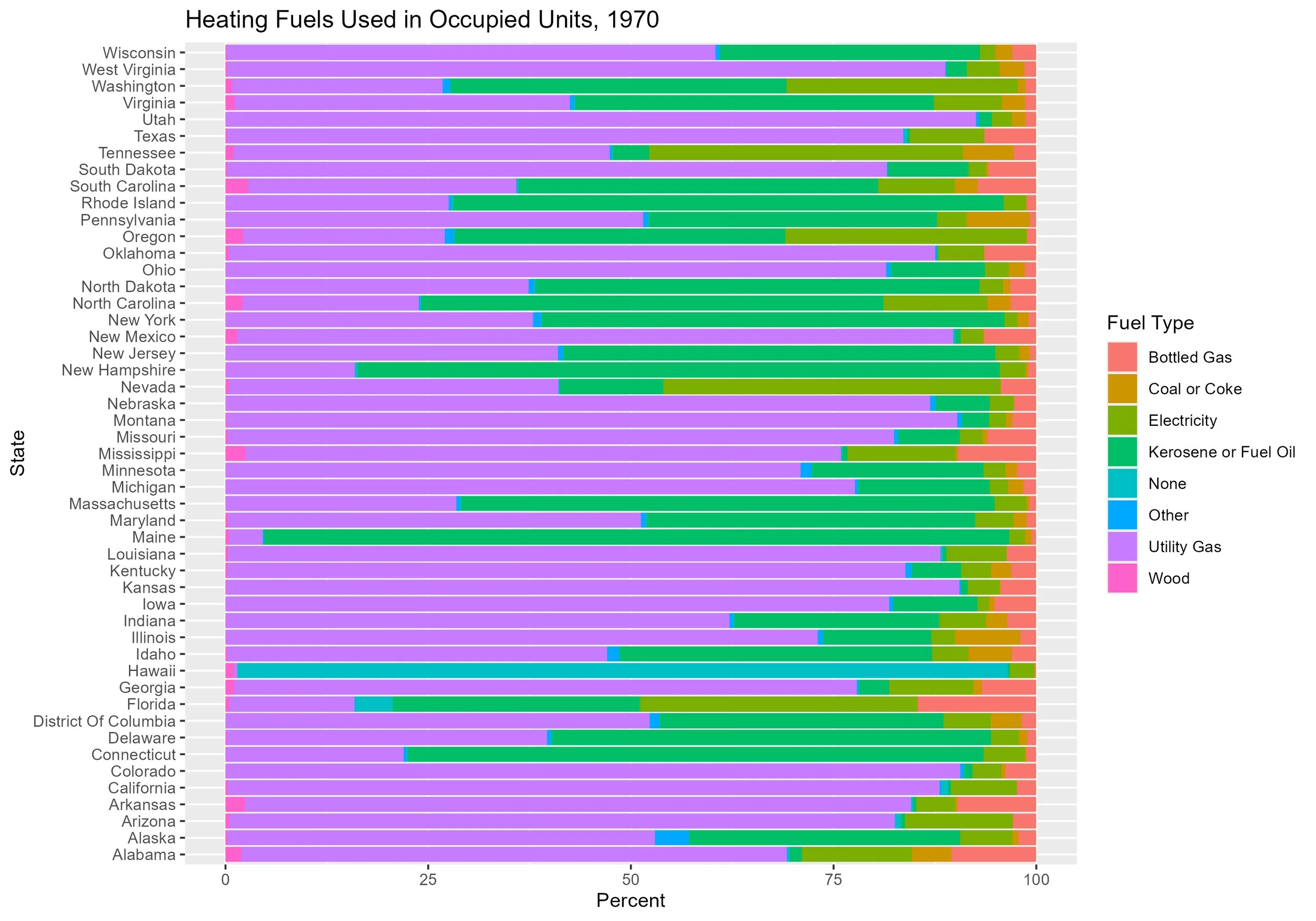
When aggregating heating fuels nationally, some clear trends begin to emerge. The most notable of these is the decline of coal from the heating mix across the board. Coal’s role in the heating mix seems to have been displaced by a slowly rising share of electrical heating and utility gas network expansion. Wood, already marginal in 1960, declined further. Notably though, the share of kerosene in the mix of heating fuels used across America stayed relatively stable. Further, there is geographic variation in the heating mix. To examine this in more detail, we turn to a comparison of New York, Washington and California.
Geography – New York, Washington and California
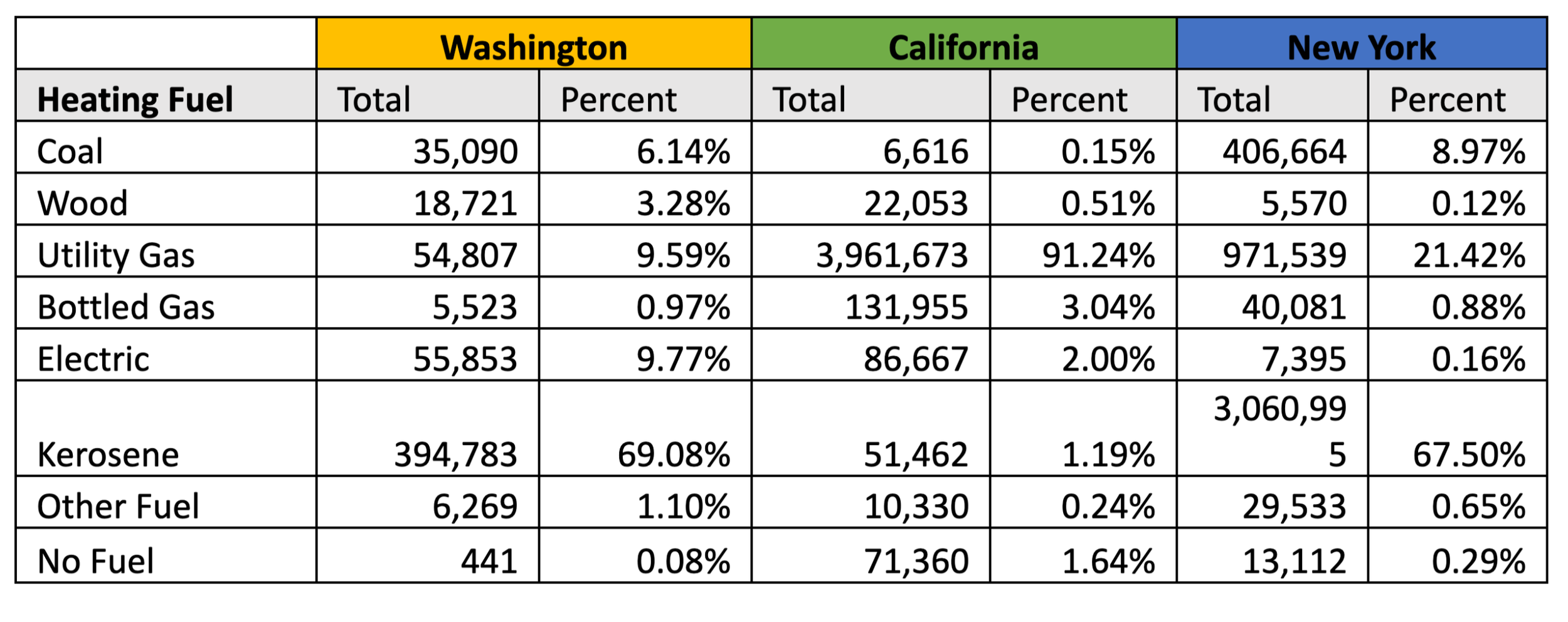
In Table 1, evidence of regional unevenness can be read easily. The most striking result is the continued dominance of kerosene in Washington and New York in 1960, accounting for roughly two-thirds of all heating fuels in both states. Electrification was far off in the heating sector, narratives of rapid post-war progress aside. In contrast, California’s energy profile is dramatically different. Most households relied on utility gas, with kerosene reduced to a marginal role. Coal remained more significant in New York than elsewhere, but its decline was already apparent in the 1960s, accelerating into the 1970s as seen in Figure 1 and 2. Rather than a uniform national transition, this table reveals a highly uneven energy landscape in which infrastructures, fuel access, and regional development trajectories matter more than any one fuel.
In the next section, we move forward in time and onto the topic of social rather than just geographical unevenness (although the two often go hand in hand). The Census datasets we are working with include information on “Negro Households” and “Spanish-American Households”.
Race and Ethnicity
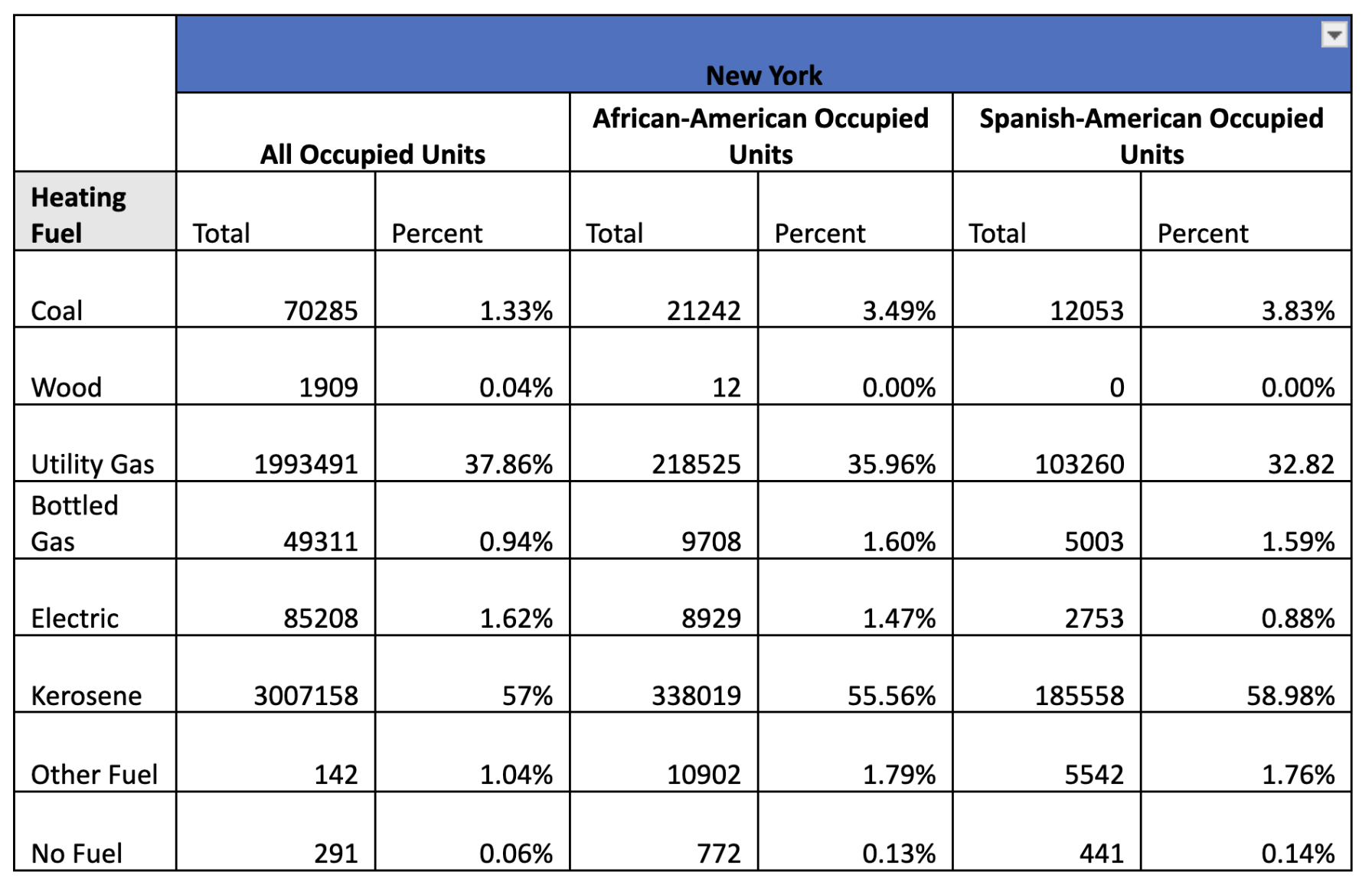
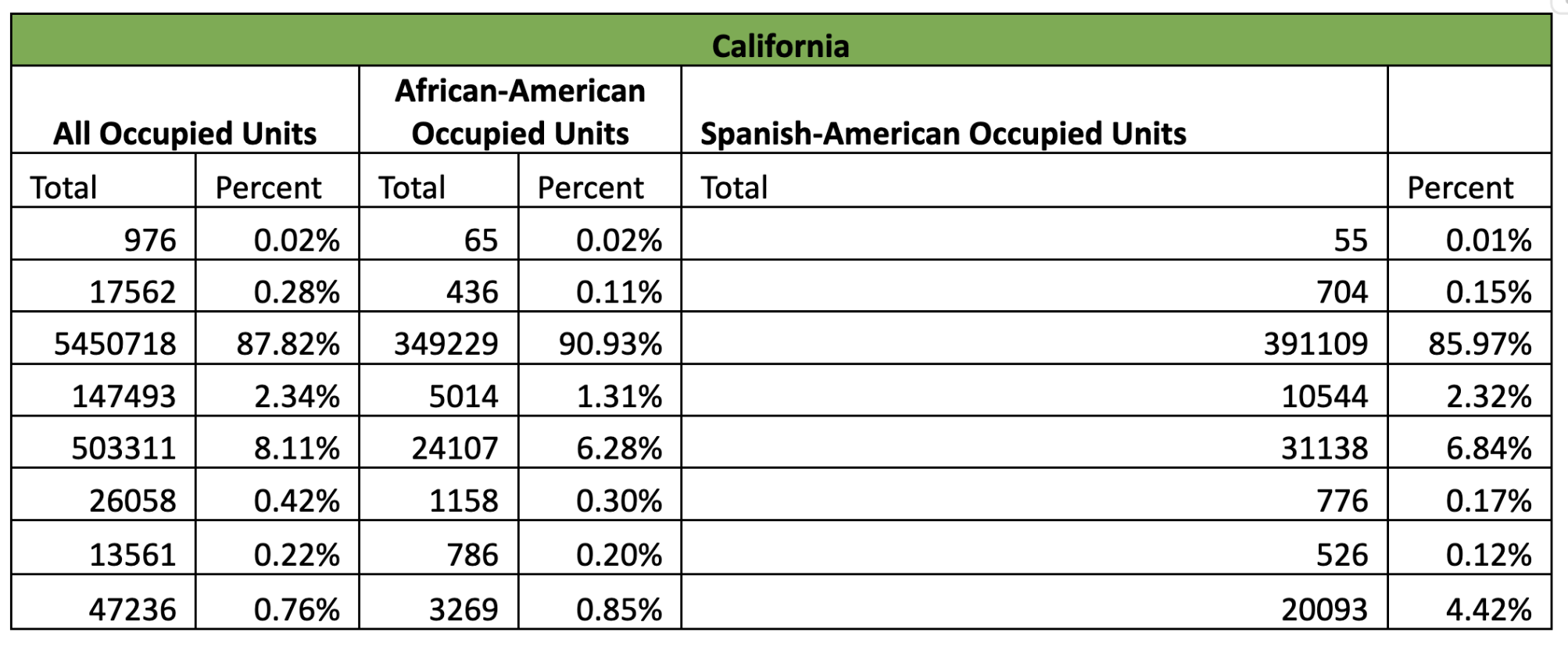
In both New York State and California, some evidence of a racially stratified energy system exists. Kerosene continued to dominate across all groups in New York State, accounting for around 57% of the heating mix of all occupied units and remaining prevalent among African American and Spanish-American households. Utility gas played a substantial but secondary role, and its share was modestly lower for African American and Spanish-American households than for the statewide average, suggesting uneven access to gas infrastructure. Coal and wood were marginal overall but proportionally more common among African American and Spanish-American households than among all occupied units. Electricity access appears uneven, marginally lower in African American and Spanish-American households. Alternative fuels and no fuel are also more prominent amongst African American and Spanish-American households.
California presents a different heating mix but a similar pattern of social unevenness. Utility gas remained the dominant heating fuel for each social group. Slowly expanding electricity access was conversely marginally lower among African American and Spanish-American households. While the fuel mix was largely similar across the other fuel sources, the prevalence of ‘no fuel’ among Spanish-American households, reaching as high as 4.42%, is a clear sign of social unevenness present in the data. Overall, both Table 2 and Table 3 reinforce that “energy transitions” unfold unevenly across energy groups, even within the same regional energy system.
Conclusion
In returning to our aim, of troubling narratives of energy transition, I want to focus on three key takeaways from this data. The first of these is that there is certainly some truth to the narrative, as coal begins to disappear from the heating mix by 1970. However, the stickiness of other infrastructures – like kerosene and gas – suggests continued caution. The moments we narrate as transitions are in fact often additive, uneven and stratified. My second point is that the clear regional divergence present in the data shows that national narratives, especially in a country as geomorphologically and climatically diverse as the United States, flatten infrastructural histories that are deeply place-specific. Finally, it bears saying that racial and ethnic stratification in fuel use reveals that unevenness was not only regional but also socially patterned.
By understanding historical energy transitions through this lens, with caution and attention to differences rather than techno-optimism, scholars can productively contribute not only to “the literature” but also to contemporary efforts at decarbonization. Energy transition, if the concept is to be kept, should be reframed less as an accomplishable fact of technological prowess but as a political and social project whose outcomes remain open and contestable.
References
Aldrich, M. (2020). The Rise and Decline of the Kerosene Kitchen: A Neglected Energy Transition in Rural America, 1870–1950. Agricultural History, 94(1), 24–60. https://doi.org/10.3098/ah.2020.094.1.024
Jonathan Schroeder, David Van Riper, Steven Manson, Katherine Knowles, Tracy Kugler, Finn Roberts, and Steven Ruggles. IPUMS National Historical Geographic Information System: Version 20.0 1960 Census: Population & Housing Data. Minneapolis, MN: IPUMS. 2025. http://doi.org/10.18128/D050.V20.0
Jonathan Schroeder, David Van Riper, Steven Manson, Katherine Knowles, Tracy Kugler, Finn Roberts, and Steven Ruggles. IPUMS National Historical Geographic Information System: Version 20.0 1970 Census: Count 4H - Sample-Based Housing Data. Minneapolis, MN: IPUMS. 2025. http://doi.org/10.18128/D050.V20.0
Resilience. (2024, December 5). Historian Jean-Baptiste Fressoz: ‘Forget the energy transition: there never was one and there never will be one.’ Resilience. https://www.resilience.org/stories/2024-12-05/historian-jean-baptiste-fressoz-forget-the-energy-transition-there-never-was-one-and-there-never-will-be-one/
York, R., & Bell, S. E. (2019). Energy transitions or additions?: Why a transition from fossil fuels requires more than the growth of renewable energy. Energy Research & Social Science, 51, 40–43. https://doi.org/10.1016/j.erss.2019.01.008